


Paper and AC Biode website selected to be featured by the Society of Fiber Science and Technology, Japan
Luxembourg / Kyoto – 25 May 2026 – AC Biode announced that R&D team member Sarah Sultan Awad Sultan has received the 2025 Journal of Fiber Science and Technology (JFST) Paper Award for her article “Nanofiber Fabrication of Alginate Ion Complexes with Different Cationic Surfactants,” published in JFST Vol. 81, No. 7 (2025). In connection with this recognition, the paper has been selected to be presented at the Society of Fiber Science and Technology, Japan (SFSTJ).
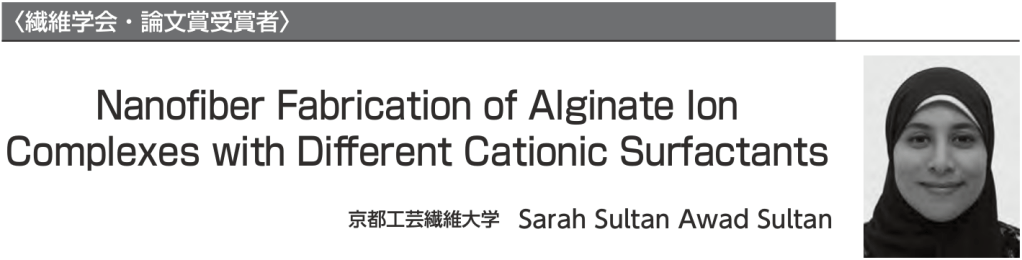
Presentation at the 2026 SFSTJ Annual Meeting
The award will be formally presented at the 2026 Annual Meeting of the Society of Fiber Science and Technology, Japan, held from 17 to 19 June 2026 at Tower Hall Funabori (Edogawa-ku Sogo Kumin Hall) in Tokyo. The conference is organized by SFSTJ and brings together researchers and companies active in fiber science, polymers, textiles, and bio‑based materials, featuring a special lecture by Professor Takashi Uemura of the University of Tokyo. The JFST Paper Award ceremony is scheduled for 18 June 2026, 16:00–16:30 in Hall A, as part of the meeting’s official awards program. You can read more here: https://www.fiber.or.jp/eng/
Summary of the Award‑Winning Technology
The winning paper tackles a longstanding challenge in fiber science: how to produce highly purified alginate nanofibers by electrospinning. Alginate normally forms extensive hydrogen‑bonded networks in water, leading to early gelation and very high viscosity at low concentrations, which makes stable nanofiber formation nearly impossible.
Sultan and co‑authors introduce a novel strategy in which anionic alginate is first converted into ion complexes with carefully chosen cationic surfactants, suppressing hydrogen‑bonded self‑aggregation and gelation while keeping the material processable. They then analyze the molecular structure and rheology of these soluble ion complexes and successfully electrospin them into continuous alginate‑based nanofibers, demonstrating that ion‑complex design can unlock fiber formation from otherwise intractable biopolymers.
By comparing alginate ion complexes made with different cationic surfactants—hexadecylpyridinium chloride (HDPyCl) and hexadecyltrimethylammonium bromide (HDTMABr)—the study shows that the cationic head group strongly controls solution behavior, fiber morphology, and bulk properties. Films of these ion complexes are water‑insoluble but soluble in ethanol, exhibit distinct thermal and mechanical characteristics, and display antibacterial activity that varies with surfactant type. Together, the results establish a tunable, fully bio‑based nanofiber platform with promising functionality for medical, environmental, and packaging applications where alginate’s biocompatibility and sustainability are key advantages.
Recognition by the JFST Award Committee
In its citation, the JFST award committee praised the work’s originality in enabling nanofiberization of high‑purity alginate—previously considered extremely difficult—by using cationic surfactant ion complexes to suppress gelation and self‑aggregation. The committee also highlighted the depth of the study in linking molecular‑level ion‑complex structure and solution rheology to macroscopic fiber formation, and emphasized the importance of such bio‑based, synthetic‑polymer‑free materials for future medical and environmental technologies.
Comment from AC Biode
AC Biode commented: “Sarah’s achievement exemplifies how advanced fiber science and green chemistry can come together to open entirely new material platforms. Her award‑winning work on alginate nanofibers aligns perfectly with AC Biode’s mission to turn bio‑based and waste‑derived resources into high‑value functional materials.”
How the Research Connects to AC Biode’s Work
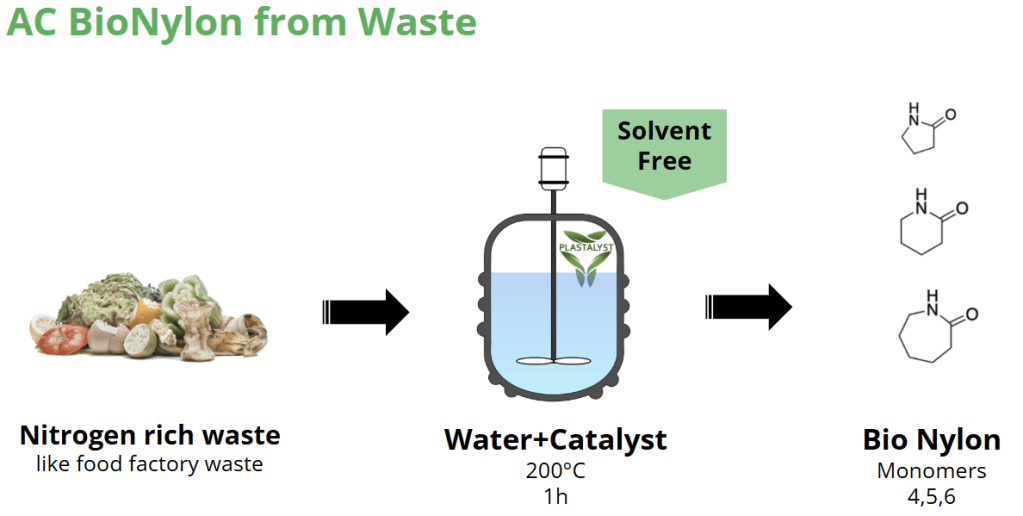
Sultan’s expertise in bio‑based materials and nanofiber fabrication complements AC Biode’s broader portfolio of green chemical technologies, which includes Plastalyst catalysts for low‑temperature depolymerization of plastic waste, Reco Glass technology that converts captured CO₂ into glass materials, AC Battery System solutions, and other platforms for metal recovery and bio‑based superabsorbent polymers. By integrating award‑winning academic research on alginate nanofibers into its R&D pipeline, AC Biode aims to accelerate the translation of fiber‑based green technologies from laboratory research to commercial products.
Timeline
- May 2025 – JFST publishes “Comparison of the Structural and Physical Properties of Two Alginate Ion Complexes with Different Cationic Surfactants,” establishing the structural and functional differences between two alginate–surfactant ion complexes (A‑HPy and A‑HTm).
- July 2025 – JFST publishes “Nanofiber Fabrication of Alginate Ion Complexes with Different Cationic Surfactants” (Vol. 81, No. 7, pp. 100–109), reporting successful electrospinning of highly purified alginate via ion‑complex formation and detailed rheological and structural analysis.
- Late 2025 – The Society of Fiber Science and Technology, Japan selects Sultan’s paper for the 2025 JFST Paper Award, as announced in SFSTJ communications and the society’s 2025 awards listing.
- 17–19 June 2026 – The 2026 SFSTJ Annual Meeting is held at Tower Hall Funabori in Tokyo; the JFST Paper Award ceremony, including recognition of Sultan’s work, takes place on 18 June 2026.
- 2026 onward – AC Biode and Sarah Sultan Awad Sultan work to explore industrial applications of alginate ion‑complex nanofibers within AC Biode’s portfolio of green chemical and materials technologies.
Read more at
FSTJ publications page for JFST: https://www.fiber.or.jp/eng/publications/index.html
Society of Fiber Science and Technology, Japan homepage: https://www.fiber.or.jp/eng/


Leave a Reply