


In an interview with the presidents dictionary CEO Tadashi Kubo gives insights into the background of AC Biode.

—When I was in the UK, I received funding from EIT InnoEnergy, a semi-governmental and semi-private venture capital under the EU, but since the UK left the EU, we relocated in Luxembourg. Just when we were thinking of building a research facility in Luxembourg, a lockdown was imposed due to the spread of the new coronavirus infection.—

According to Mr. Kubo, building a research facility costs a huge amount of money, so if the lockdown continues, there is a risk of bankruptcy. Therefore, we decided to locate our facility in Japan, where there is virtually no lockdown, and launched the AC Biode laboratory in Kyoto in 2019. The company still has its headquarters in Luxembourg and offices in the UK, and operates in Europe and Japan.
Our company has a mission of “Using chemical technology to contribute to reducing global greenhouse gases, solving global garbage problems including marine plastics, and improving recycling rates,” and we are currently developing five main businesses.
The first is the development of a catalyst that depolymerizes waste plastic into monomers (the smallest units that make up plastic). We succeeded in depolymerizing plastic to methanol for the first time in the world, and it is currently our company’s most popular business. We have also successfully applied this technology to decompose organic waste such as food residue and sludge into hydrogen and fuel materials.
Second, in collaboration with Revcel, we use filters to adsorb CO2 from the air, solidify it, and recycle it as raw material for glass, or mix it with cement to recycle it into construction materials, luxury beauty product containers, etc. .
Third, we are developing AC batteries and circuits, and are conducting demonstration experiments on electric motorcycles, robots, etc.
The fourth step is the development of a glucose measurement sensor that measures blood sugar levels. In fact, our company’s Mizusawa is the inventor of the blood sugar sensor, and we are currently continuing to develop it together with universities and pharmaceutical companies.
Fifth, we have obtained a patent for fine particle synthesis technology that can turn raw material liquids for a wide range of applications into droplets (clumps of liquid held together by surface tension). This makes it possible to create micro-based liquid balls, which we plan to use in drug delivery systems for transporting drugs within the body and in food fermentation.
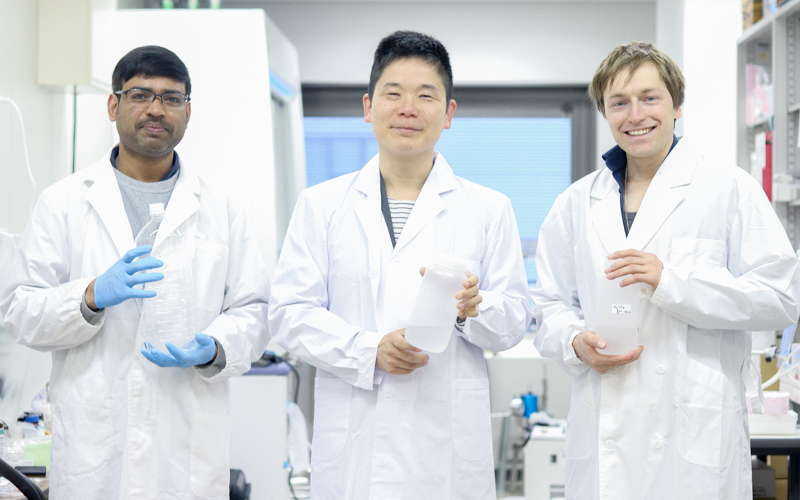
AC Biode´s lab brings together researchers from 4 different countries already. Read the full press article here in Japanese:


Leave a Reply